The AI Agent Revolution is Already Here (And It's Not What You Think)
The 2026 State of AI Agents Report details a major transition as organizations shift from experimental pilots to autonomous production systems.

We've all been hearing about AI for years now. The promises, the hype, the "this will change everything" declarations that somehow never quite materialize. But here's the thing—something fundamental has shifted, and most of us are still thinking about AI the wrong way.
I just went through "The 2026 State of AI Agents Report" (a survey of 500+ technical leaders), and honestly, the findings challenged pretty much everything I thought I knew about where we are with AI in business. Let me share what really stood out.
Stop Waiting for ROI—It's Already Happening
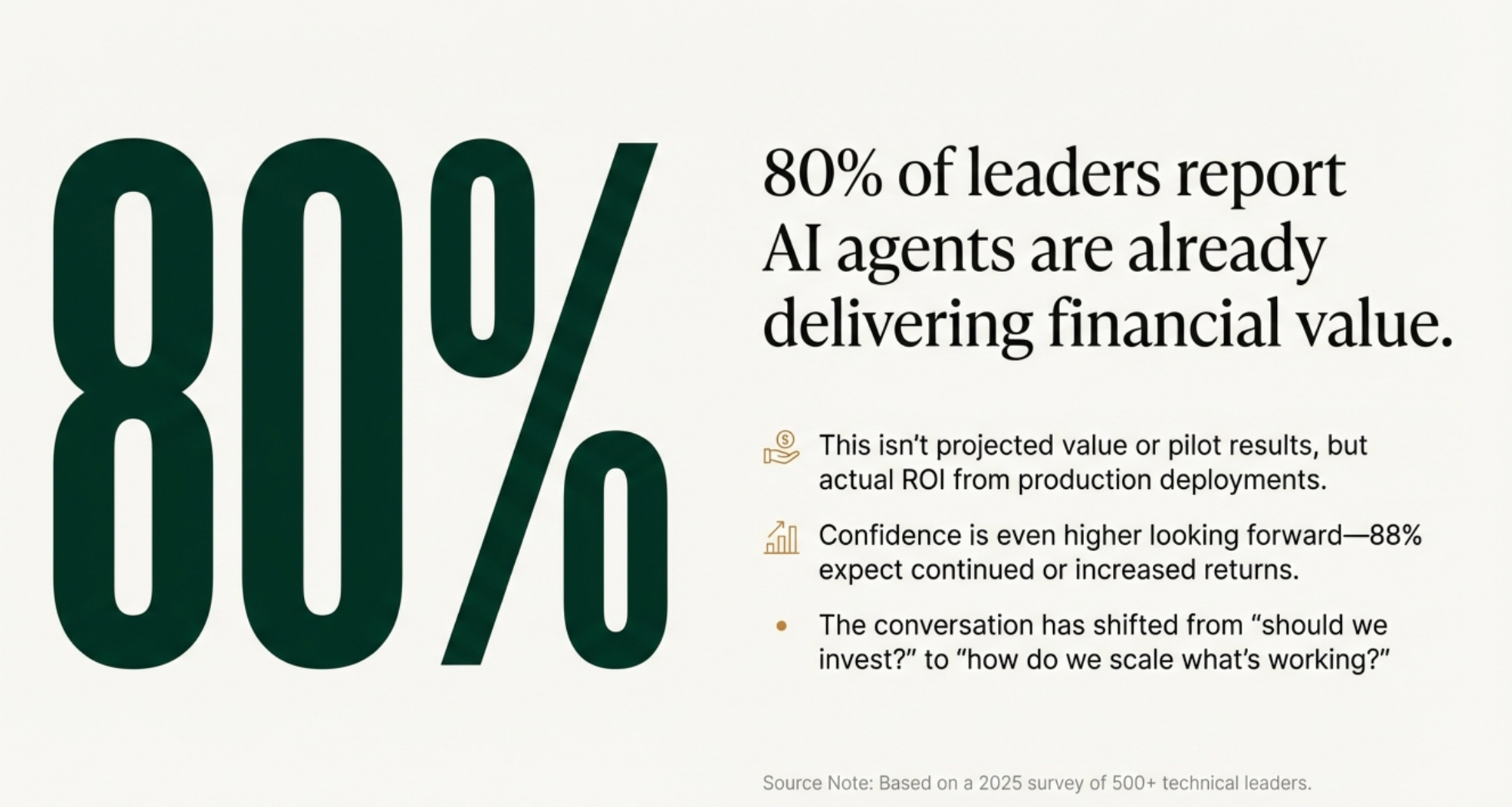
Here's the headline that should make every business leader sit up: 80% of organizations report that their AI agent investments are already delivering measurable financial returns. Not "we hope to see returns" or "our projections show." Actual, in-production ROI. Right now.
This isn't some distant future we're planning for. Companies aren't running pilots anymore—they're scaling what's already working.
Think about that for a second. The conversation has fundamentally shifted from "Should we invest in AI?" to "How do we scale what's already working?" That's a completely different game.
AI Isn't Replacing Workers—It's Elevating Them
Here's where it gets interesting. You know all that doom and gloom about AI taking jobs? The data tells a very different story.
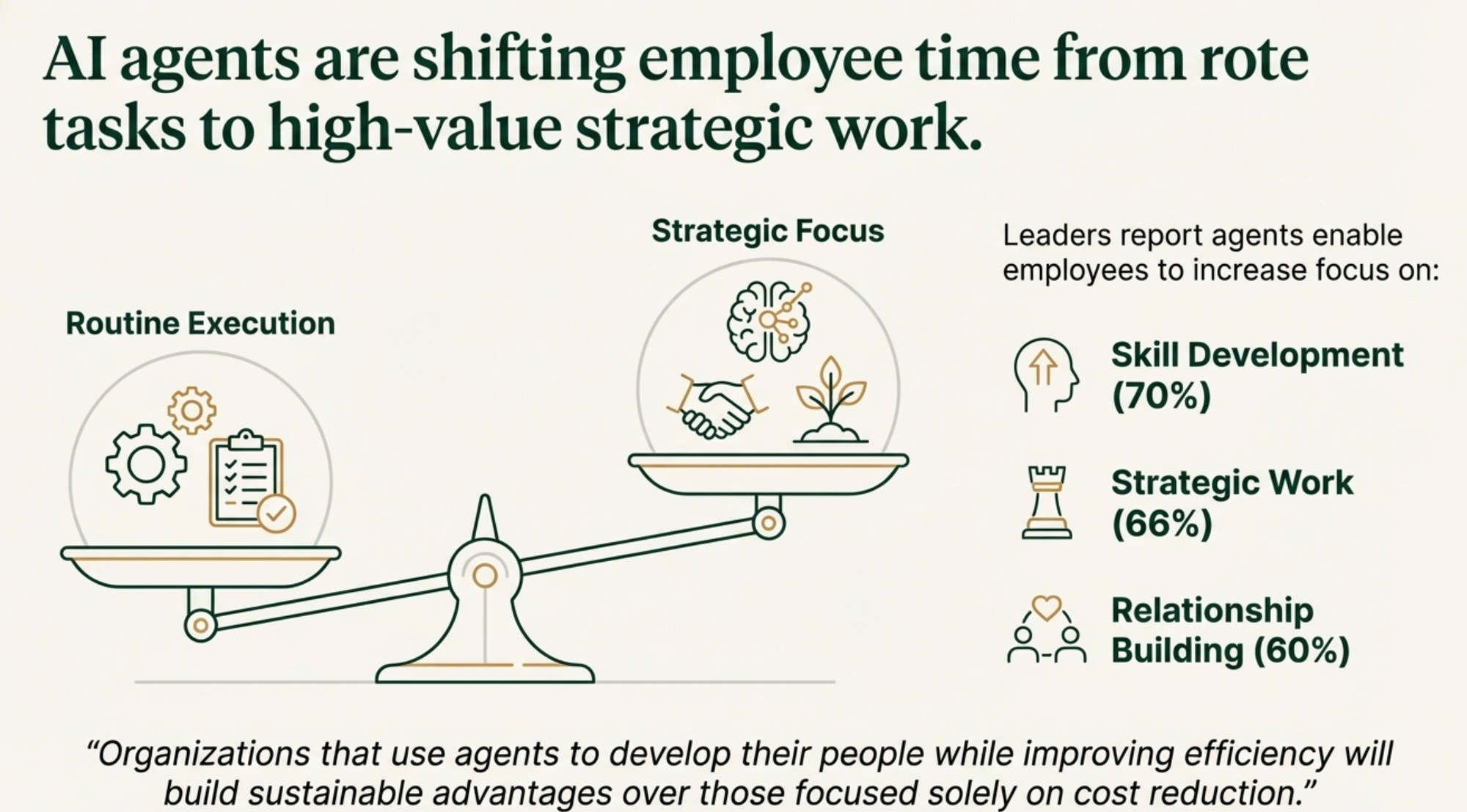
Organizations are reporting that AI is actually increasing the time employees spend on strategic work (66%), relationship building (60%), and skill development (70%).
Let that sink in. Instead of making people obsolete, AI is freeing them up to do the uniquely human stuff—the thinking, the connecting, the learning. The boring, repetitive tasks? Yeah, the machines are handling those.
I've seen this firsthand. When developers aren't spending hours debugging the same recurring issues or writing boilerplate code, they're architecting better solutions and mentoring junior team members. That's not job displacement—that's job elevation.
The Real Roadblock Isn't AI—It's Your Data
Want to know the dirty little secret about AI adoption? The technology isn't the problem. Your infrastructure is.
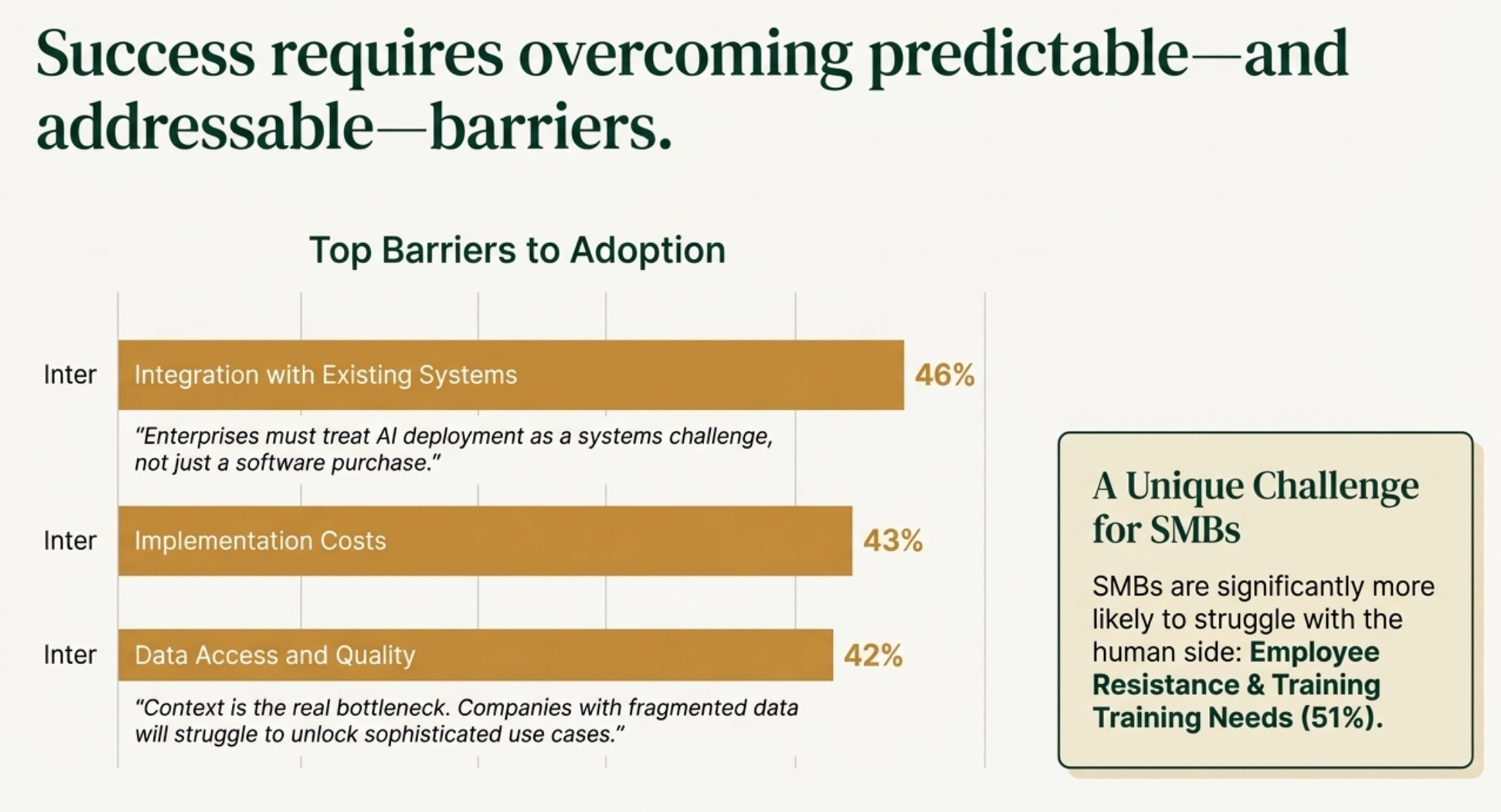
Survey respondents pointed to integration with existing systems (46%) and data access and quality issues (42%) as the primary obstacles. Not model capabilities. Not cost. Not even resistance to change (though that's important too).
Here's what this means in plain English: if your data is scattered across fifteen different systems, locked in silos, or just plain messy, you're going to struggle. It doesn't matter how advanced the AI models become.
The companies winning with AI? They're the ones who did the unglamorous groundwork—cleaning up their data infrastructure, breaking down silos, making information accessible. Not sexy, but absolutely critical.
Developers Aren't Just Coding Faster—They're Working Smarter
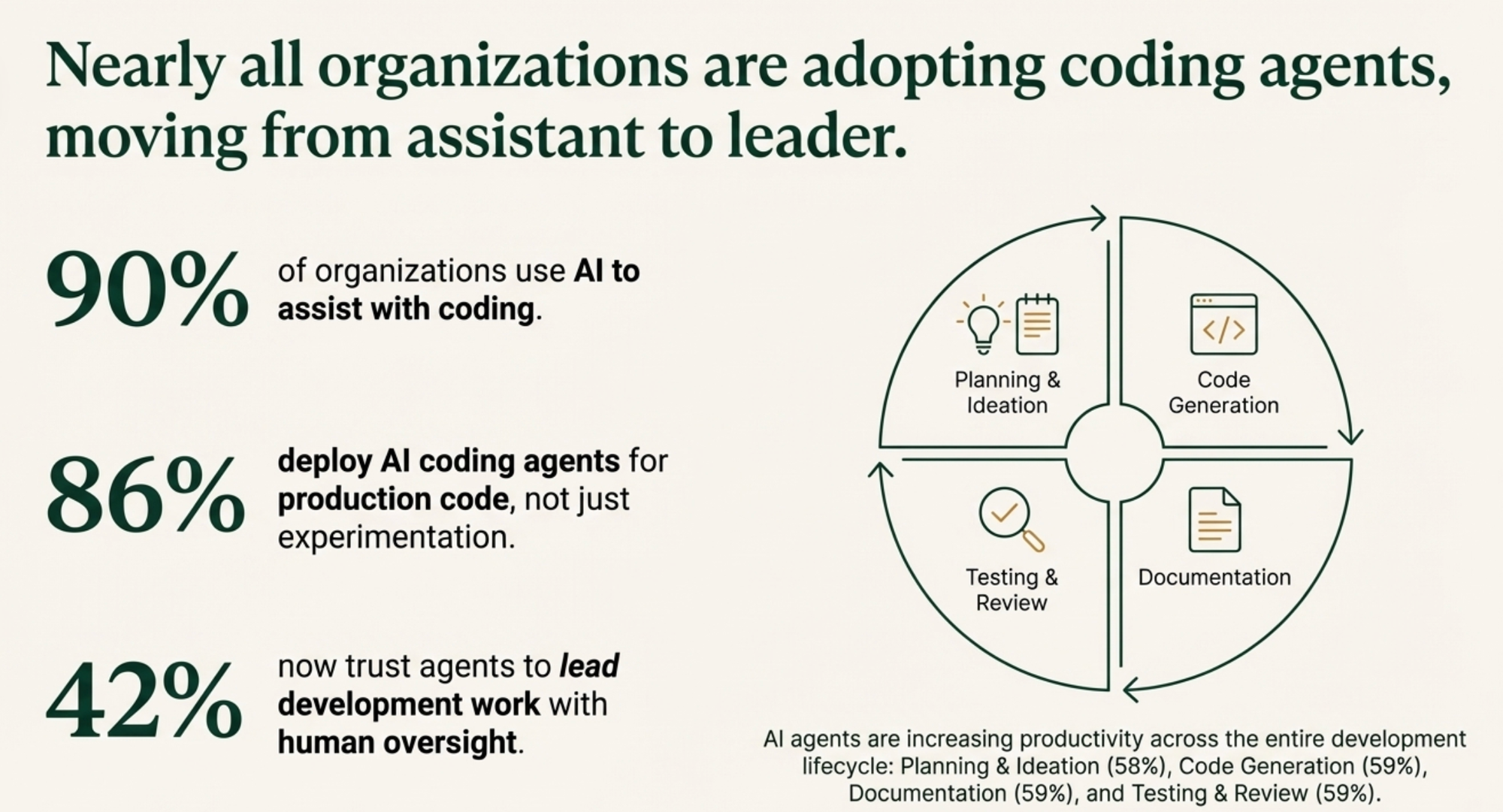
Nearly 90% of organizations use AI for coding. No surprise there. But here's what blew my mind: the productivity gains are almost evenly distributed across the entire software development lifecycle.
Planning and ideation? 58% report time savings. Code generation? 59%. Research and documentation? 59%. Code review and testing? 59%.
See the pattern? This isn't just about autocompleting code. It's about accelerating every single phase of development. And when you stack those improvements, you're not getting 10% faster—you're fundamentally changing how quickly you can ship quality software.
Businesses Are Going Straight to Delegation
Here's maybe the most surprising finding: 77% of business API usage shows automation patterns—meaning companies are handing off complete tasks to AI, not using it as a collaborative assistant.
We all thought AI would be this helpful sidekick, right? The thought partner that makes suggestions while you do the real work?
Nope. Businesses are delegating entire tasks. And this trend is accelerating fast. In just eight months, "directive conversations" jumped from 27% to 39%.
What does this look like in practice? Instead of asking AI to "help me draft this email," people are saying "handle this customer inquiry from start to finish." Instead of "suggest some code improvements," it's "build this feature according to these specs."
That's a fundamentally different relationship with AI.
The Real-World Examples Are Wild
Let me share a few that really stuck with me:
Novo Nordisk cut clinical study report generation from 10+ weeks to 10 minutes. Think about that—work that used to take months now happens before you finish your coffee. And we're talking about highly regulated pharmaceutical documentation, not blog posts.
Lovable enables users to ship code 20x faster than manual development. A startup hit $40 million ARR within six months by making it possible for non-technical people to build actual, working software.
eSentire compressed threat analysis from 5 hours to 7 minutes with 95% alignment to their senior security experts. We're talking about protecting critical infrastructure here—not exactly a low-stakes use case.
These aren't pilot programs or proof-of-concepts. This is production stuff, handling real customers, real revenue, real security threats.
What This Means for You
If you're reading this thinking "okay, this sounds great, but what should I actually do?"—here's my take:
1. Stop waiting for perfect conditions. 80% of companies are already seeing ROI. If you're still in "let's explore this" mode, you're falling behind.
2. Fix your data infrastructure first. Before you spend another dollar on fancy AI tools, make sure your data is accessible, organized, and actually usable. This is the bottleneck.
3. Think delegation, not collaboration. Don't just use AI to make suggestions. Identify complete tasks you can hand off entirely. That's where the real productivity gains are.
4. Invest in your people. The companies winning with AI aren't cutting headcount—they're training people to work at a higher level. Strategic thinking, relationship building, leadership. That's the human premium.
5. Start simple, then scale. Nearly half (47%) of organizations use a hybrid approach—combining off-the-shelf solutions with custom builds. You don't need to build everything from scratch.
The Bottom Line
The era of tentative AI pilots is over. We're past experimentation. The companies thriving in 2026 won't be the ones who use AI—it'll be the ones who fundamentally redesign their operations around it.
As Alex Holt from Accenture puts it: "Companies treating this as a technology implementation challenge will see incremental gains. Those recognizing it as a reinvention imperative will create compounding advantages that become impossible to replicate."
AI agents aren't coming. They're here. They're working. They're delivering real results.
The only question left is: are you ready to work with them?