The Rise of the Augmented Developer: Why AI Won't Replace You - It Will Make You Unstoppable
Every engineering team is asking the same question: Will AI replace developers? The answer is no but it will redefine what a developer does.

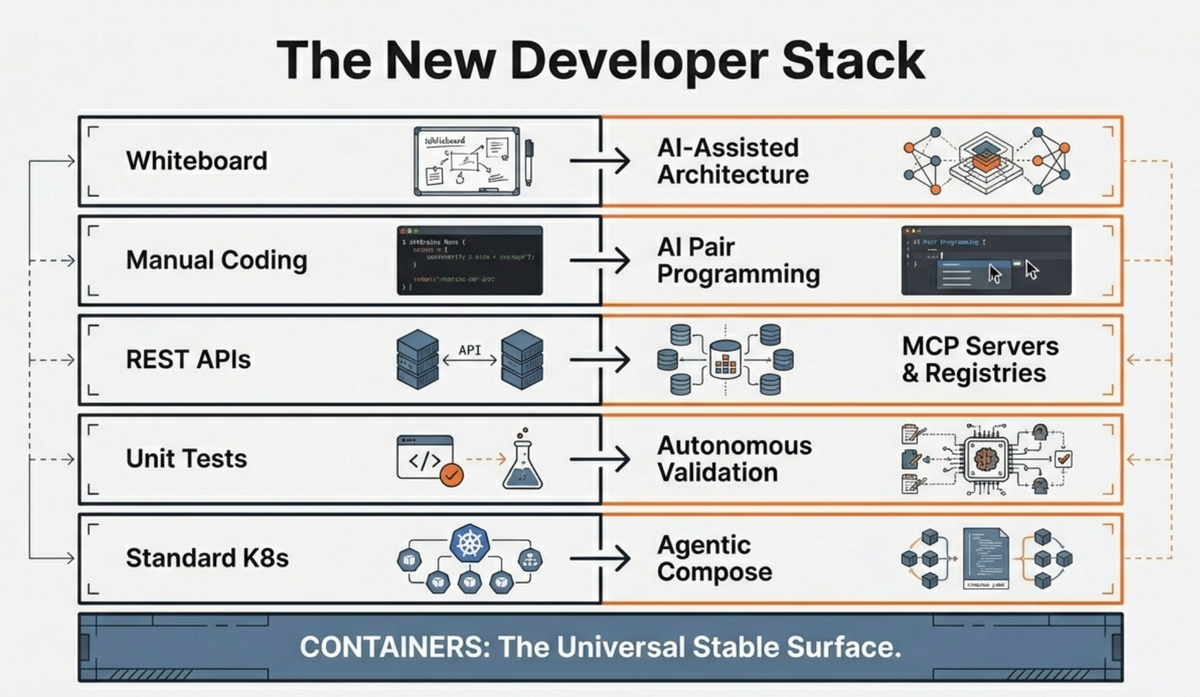
In 2023, we learned to talk to AI models. In 2024, we learned to chain them together. In 2025, we gave them real power. And now in 2026, a new archetype is emerging in the software world - the Augmented Developer.
Not replaced. Not threatened. Augmented.
If you're a developer who's been watching AI agents evolve from party tricks to production-grade systems, you already sense it: the ground beneath our feet is shifting. But unlike previous technological disruptions, this one doesn't make developers obsolete. It makes them dangerous - in the best possible way.
Let me explain.
What Is an Augmented Developer?
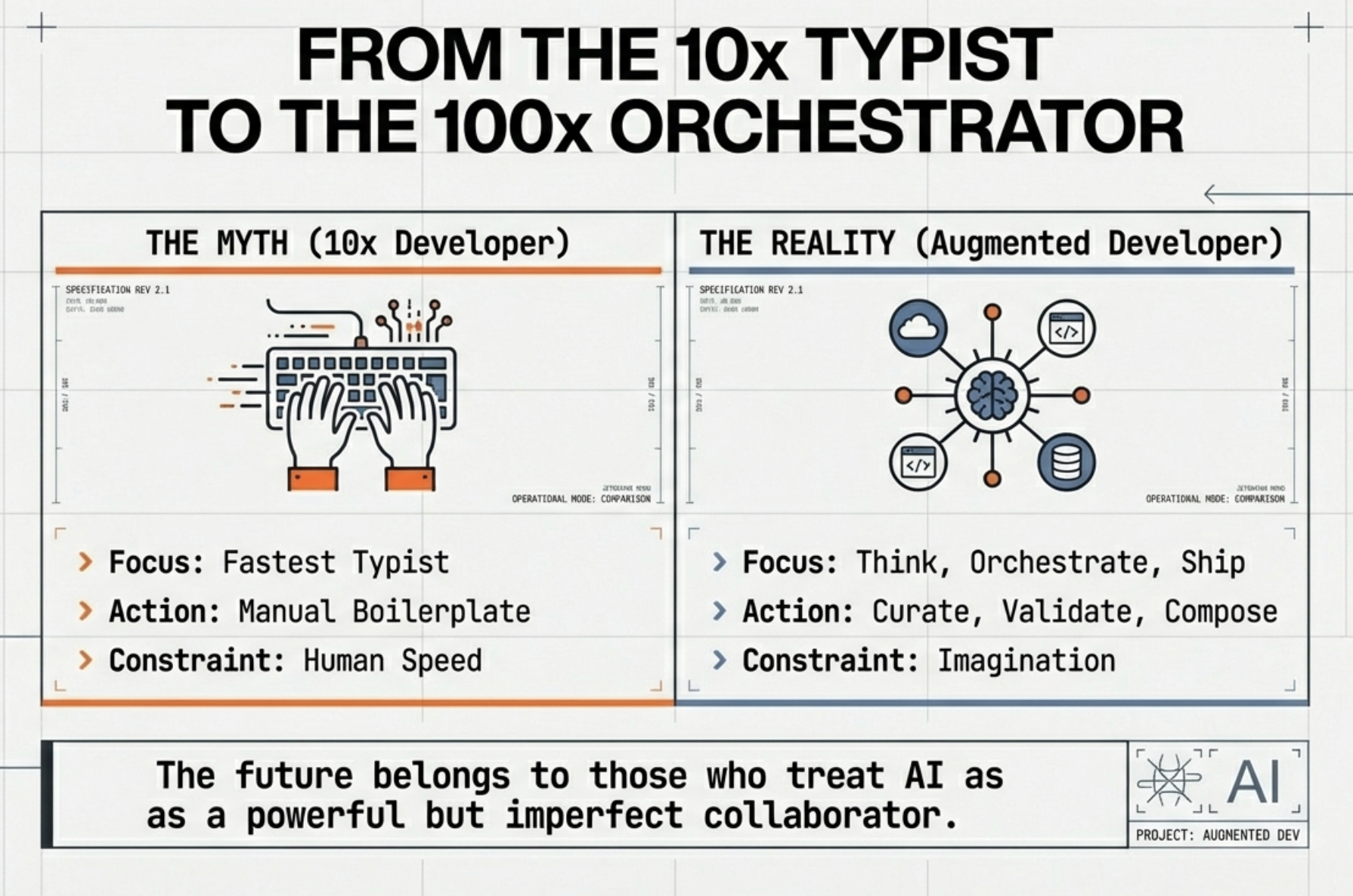
An augmented developer isn't someone who blindly copies code from ChatGPT and ships it. That's a shortcut. An augmented developer is a craftsperson who understands their tools deeply and has now gained an entire layer of AI-powered capability on top of their existing expertise.
Think of it this way: A surgeon doesn't become less skilled because they use robotic-assisted surgery. They become more precise, more capable, and able to handle cases they couldn't before. The robot doesn't replace judgment - it amplifies it.
The same is happening with software developers. The 2025 Stack Overflow Developer Survey tells a nuanced story: while 52% of developers say AI tools have positively impacted their productivity, 66% cite their biggest frustration as AI solutions that are "almost right, but not quite." The gap between "almost right" and "production-ready" is exactly where the augmented developer lives.
That gap is not a bug. It's a moat.
The Three Layers of Developer Augmentation
I've been observing this transformation closely through the Collabnix community - 17,000+ developers building with Docker, Kubernetes, and increasingly with AI agents. Here's how I see the augmentation stack:
Layer 1: AI as Your Copilot (2022–2024)
This is the layer most developers know. GitHub Copilot, Claude, ChatGPT - tools that autocomplete code, generate boilerplate, and answer Stack Overflow questions faster than you can type them. Useful? Absolutely. Transformative? Not yet.
The danger at this layer is overreliance. Vibe coding - letting AI generate entire applications from prompts - has exploded in popularity. But the 2025 developer survey found that 72% of professional developers say vibe coding is NOT part of their professional workflow. Why? Because shipping AI-generated code without understanding it is like driving a car blindfolded. It might work for a while, but the crash is inevitable.
Layer 2: AI as Your Teammate (2025)
This is where things get interesting. In 2025, agents stopped being prototypes and started doing operational work. Not just suggesting code, but updating infrastructure, resolving customer issues, managing SaaS tools, and coordinating multi-step workflows.
The Model Context Protocol (MCP) became what Docker's blog aptly called "the USB-C port of AI" - a universal standard for agents to safely access tools, data, and workflows. Suddenly, the question changed from "Can AI write my code?" to "Can AI be a productive member of my team?"
Docker's evolution here is particularly telling. Docker Compose, which solved the multi-container orchestration problem a decade ago, now lets you define agentic architectures — agents, models, and tools - in a single YAML file. The same docker compose up experience that deployed your microservices now deploys your AI agents. The developer workflow didn't break. It expanded.
Layer 3: AI as Your Force Multiplier (2026 and Beyond)
This is the layer we're entering now. The augmented developer doesn't just use AI tools - they architect AI systems. They design multi-agent architectures where specialized AI agents collaborate, check each other's work, and deliver results that neither humans nor AI could achieve alone.
Consider the pattern emerging in agentic AI: an Auditor agent that coordinates a Critic (which verifies factual claims) and a Reviser (which refines outputs based on verification). This isn't a single AI generating code. It's a system of checks and balances - and the developer is the architect of that system.
The augmented developer at this layer understands prompt engineering, agent orchestration, tool integration, security boundaries, and model selection. They're not writing every line of code. They're designing the system that writes, tests, and deploys code - and they know exactly where human judgment must intervene.
Why Containers Are the Foundation of the Augmented Developer Stack
Here's something that gets lost in the AI hype: every production-grade AI agent runs inside containers.
More than 90% of companies already use containers as their default execution environment. When you give AI agents the power to act autonomously, containment isn't optional - it's existential. You need consistent, reproducible environments. You need security boundaries. You need to know exactly what's running inside your base image.
This is why Docker Hardened Images matter so much in the agentic era. When the cost of doing the right thing (using a secure, vetted base image) dropped to zero, the entire supply chain security equation changed. You can't trust an AI agent if you can't trust the environment it runs in.
The augmented developer understands this deeply. They don't just build AI features. They build trustworthy AI systems - with isolation, observability, and guardrails baked in from day one.
The Skills That Define the Augmented Developer
If you're wondering how to future-proof your career, here's the skill matrix I see emerging:
1. System Design Thinking - The ability to architect multi-agent systems, define communication patterns between agents, and design failure modes. This is the new "microservices architecture" skill.
2. Prompt Engineering and Model Selection - Knowing which model to use for which task. Frontier models for complex reasoning. Small local models for fast inference. The augmented developer treats models like tools in a toolbox, not as a single oracle.
3. Security-First Mindset - Understanding blast radius. When agents can act autonomously, the security question shifts from "filter danger out of the model" to "contain the damage if something goes wrong." Containers, sandboxes, and MCP gateways are your friends.
4. Infrastructure as Code for AI - Writing Docker Compose files that define agent architectures. Using MCP Gateway as a unified control plane. Deploying from laptop to cloud with the same configuration. The DevOps skills you've built? They're more valuable than ever.
5. Critical Evaluation - The most underrated skill. The augmented developer knows when to trust AI output and when to verify. They are, as the Stack Overflow survey put it, "the ultimate arbiters of quality and correctness."
The Rameshwaram Cafe Analogy
I often use Rameshwaram Cafe in Bengaluru to explain complex tech concepts, so bear with me on this one.
Rameshwaram Cafe is famous for its dosas. But the magic isn't just in the recipe - it's in the system. The batter is prepared with precision. The griddle is at the exact right temperature. The filling is consistent across thousands of servings. The speed of service is legendary.
Now imagine giving the kitchen AI-powered tools: a system that monitors griddle temperature in real-time, predicts ingredient demand based on foot traffic patterns, and automatically adjusts cooking times. Would that replace the cooks? Not a chance. The craft, the judgment, the ability to taste and adjust that stays human. But the cooks would become augmented cooks - able to serve more people, with more consistency, and less waste.
That's what's happening to developers. The craft stays. The judgment stays. The creativity stays. But the throughput, the consistency, and the reach? Those are about to go through the roof.
What This Means for the Developer Community
At Collabnix, we've been building Docker workshops and meetups for years. What I'm seeing now is a fundamental shift in what developers want to learn:
- Two years ago: "How do I containerize my Node.js app?"
- One year ago: "How do I run an LLM locally with Docker Model Runner?"
- Today: "How do I build a multi-agent system with Docker Compose that uses MCP Gateway, local models, AND cloud inference — all deployed with one
docker compose up?"
The questions are getting more sophisticated because the developers are becoming more augmented. They're not afraid of AI. They're integrating it into their existing workflow — the same workflow they've refined over years of building containerized applications.
And here's the most encouraging data point: the term "AI engineer" is already fading. What remains is what has always been — software engineers who build secure, governable, and resilient systems. The tools have changed. The mission hasn't.
The Bottom Line
The augmented developer isn't a future concept. It's happening now. If you're a developer who:
- Uses AI to accelerate your workflow but verifies every output
- Understands containerization and applies it to AI agent deployment
- Thinks in systems, not just code snippets
- Knows when to delegate to AI and when to intervene
- Builds with security and trust as first-class concerns
…then congratulations. You're already an augmented developer.
The developers who thrive in the next decade won't be those who resist AI, nor those who surrender to it entirely. They'll be the ones who master the art of collaboration with intelligence — both human and artificial.
The era of the augmented developer isn't about doing less. It's about doing more — more ambitious projects, more complex systems, more impactful work — with an AI-powered tailwind at your back.
Welcome to the era of the unstoppable developer.
Want to learn more? Don't miss out my session at CloudxAI 2026 conference at Nimhans Bengaluru.