Which AI Coding Tools Are Developers Actually Using at Work in 2026?

If you spend any amount of time on LinkedIn or X, you already know the feed is saturated with AI coding agents ~ Claude Code, Codex, Gemini CLI, Junie, and a new launch every other week. The hype is loud. The actual adoption inside real engineering teams is harder to read.
JetBrains just published the results of their January 2026 AI Pulse survey, which polled over 10,000 professional developers across eight languages. It's one of the few large-scale, globally representative datasets we have on what developers are actually using at work, not what they're posting screenshots of on weekends. I wanted to pull out the numbers that matter and add a bit of context for those of us building in the agentic AI space.
Full credit to the JetBrains Research team — the original report is here.
The headline number: 90%
The first stat sets the floor for everything else: in January 2026, 90% of developers regularly used at least one AI tool at work for coding and development tasks. The "do developers use AI?" debate is effectively settled.
The more interesting cut is this: 74% of developers worldwide have adopted specialized AI tools for developers — meaning AI coding assistants, AI-native editors, and coding agents, not generic chatbots like ChatGPT. That's the line that tells you the market has moved past "I paste code into ChatGPT" into purpose-built tooling.
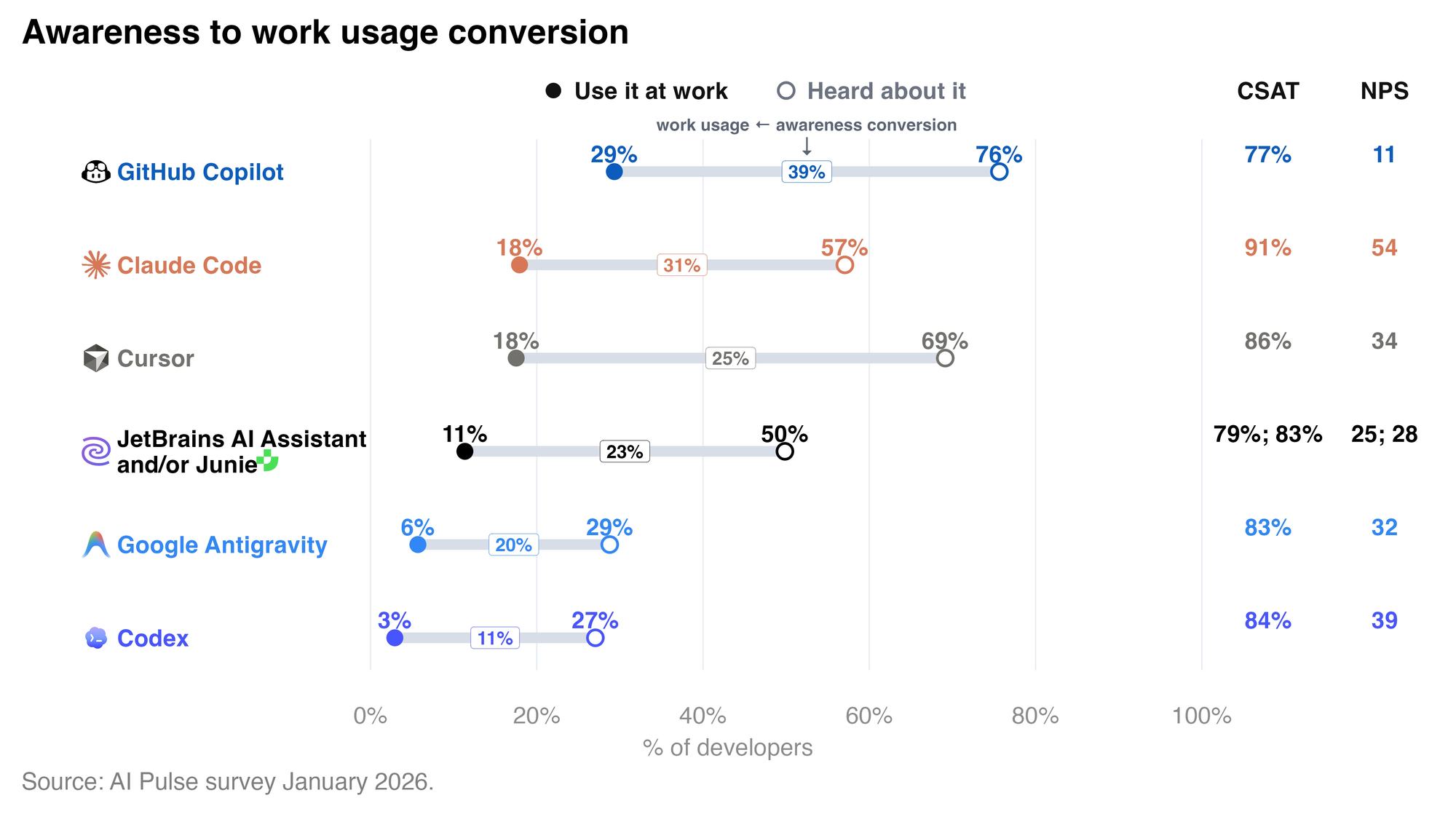
GitHub Copilot: Still on top, but growth has stalled
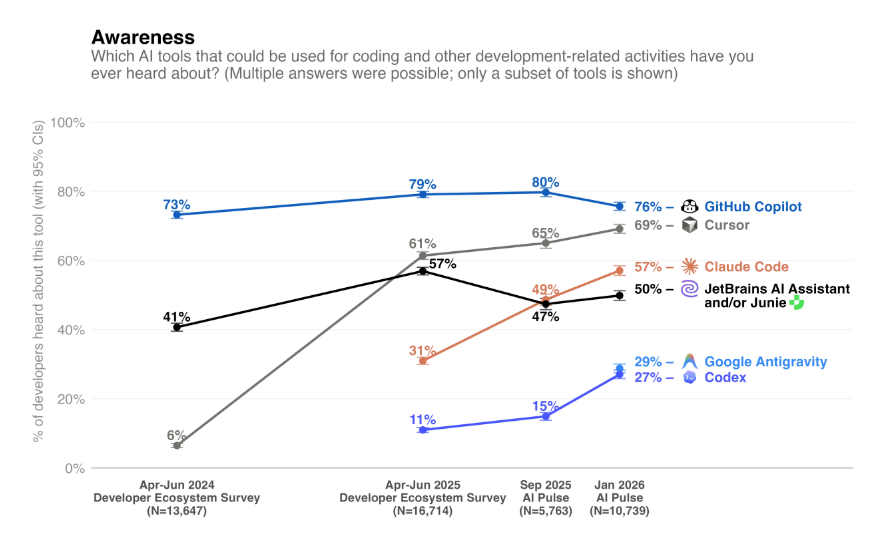
Copilot is still the most widely known and adopted AI coding tool on the planet:
- 76% awareness worldwide
- 29% of developers using it at work
- 40% adoption in companies with 5,000+ employees
But — and this is the important bit — both awareness and adoption growth have flattened since last year. Copilot's enterprise distribution advantage is real and durable, especially in large orgs where GitHub is already part of the procurement story. What it isn't doing is winning new ground.
Cursor: Plateau at #2
Cursor is the second most well-known AI dev tool with 69% awareness, but its growth has also slowed. In terms of actual adoption at work, Cursor now sits at 18% — tied with Claude Code.
Claude Code: The fastest mover on the chart
This is the section I find most interesting, and not just because I use Claude Code daily.
- 57% awareness in January 2026, up from 49% in September 2025 and 31% in April–June 2025
- 18% adoption at work — a 1.5x jump from September 2025 and roughly 6x from April–June 2025
- 24% adoption in the US and Canada
- CSAT of 91% and NPS of 54 — the highest loyalty metrics on the market
A 6x growth in about three quarters is not normal in developer tooling. And the satisfaction scores suggest this isn't just curiosity-driven adoption that will churn out next quarter — people are sticking with it.
JetBrains framed this trend as "performance over platform" — the rise of best-of-breed agents. I think that's exactly right. Developers are increasingly willing to break out of integrated stacks and pick the standalone tool that does the job best, even if it means cobbling together their workflow. When a single agent is meaningfully better, ecosystem lock-in stops mattering.
OpenAI Codex and Google Antigravity: One stalling, one launching
OpenAI's coding agent Codex sits at 27% awareness and 3% adoption at work as of January 2026. Worth noting: that data was collected before the public launch of the Codex desktop app and its in-ChatGPT promotion. The next survey wave will tell a different story. ChatGPT itself, by the way, is still used at work for coding tasks by 28% of developers — chatbots haven't been displaced.
Google Antigravity, the AI code editor Google launched in November 2025, hit 6% adoption by January 2026. That's a fast start for a brand-new product and worth watching.
Chatbots are still in the mix
Even with all the agent hype, plain chatbot interfaces are still part of the daily workflow:
- ChatGPT for coding: 28%
- Gemini chatbot: 8%
- Claude chatbot: 7%
Worth remembering when you're designing developer experiences — the "paste it in a chat window" pattern hasn't gone away.
JetBrains' own play
The JetBrains team uses the back half of their post to lay out where they're going, and it's worth summarizing because the strategy itself is a signal about where the market is heading. JetBrains AI Assistant + Junie sit at 11% combined adoption worldwide (9% AI Assistant, 5% Junie).
Their bet is on an open agentic ecosystem rather than a closed stack:
- JetBrains IDEs now integrate Claude Agent and OpenAI Codex directly in the AI chat, with dozens of other agents (including Cursor) accessible via the Agent Client Protocol.
- JetBrains Central is a control and execution plane for agent-driven development — governance, cloud-based agent runtimes, and a shared semantic layer across IDEs, CLIs, and web tools.
- Air (public preview) is a dedicated agentic IDE that runs multiple agents concurrently in isolated Docker containers or Git worktrees. The Docker-container-per-agent pattern is one I've been writing about a lot — it's the same isolation story behind Docker sbx, and it's becoming the default boundary for agent execution.
- Junie CLI (beta) is an LLM-agnostic, local-first coding agent for the terminal with Bring Your Own Key support across OpenAI, Anthropic, Google, and Grok.
The common thread across all four: model-agnostic, sandboxed, orchestratable. That maps neatly onto the "agents as microservices" pattern — independent units of work, with isolation boundaries and a control plane around them.
What this means if you're building in this space
A few things stand out to me:
The incumbent advantage is real but not durable. Copilot's 29% is impressive, but stalling growth in a market that's still expanding tells you developers are voting with their fingers. If your agent is meaningfully better at a specific task, distribution can be overcome.
Satisfaction scores predict the next 12 months. Claude Code's 91% CSAT and 54 NPS are leading indicators that its 18% adoption number will keep climbing. Watch loyalty metrics, not just install counts.
Isolation is becoming table stakes. Every serious agent platform — Air with Docker containers, sbx with microVMs, Junie CLI with local-first execution — is converging on the idea that agents need an execution boundary. If you're shipping an agent without thinking through isolation, you're behind.
The market still has room. With 74% of developers using specialized AI tools but the leaders fragmented across 18-29% bands, there's no monopoly forming. The next two years are going to be about which agent wins which workflow, not which platform wins everything.
JetBrains says they'll cover this in more depth in the Developer Ecosystem Survey 2026, launching in April. I'll be reading.